

Industrial Fuel Polishing Systems: What to Check Before You Buy One
What should you check before buying an industrial fuel polishing system?Check the test behind the filter rating, whether the system removes emulsified as well as free water, how it controls microbial growth, what "automated" covers, how it behaves on a fault, how it connects to the tank, whether it suits the site, and how the supplier will prove the result at handover.
What is an industrial fuel polishing system?
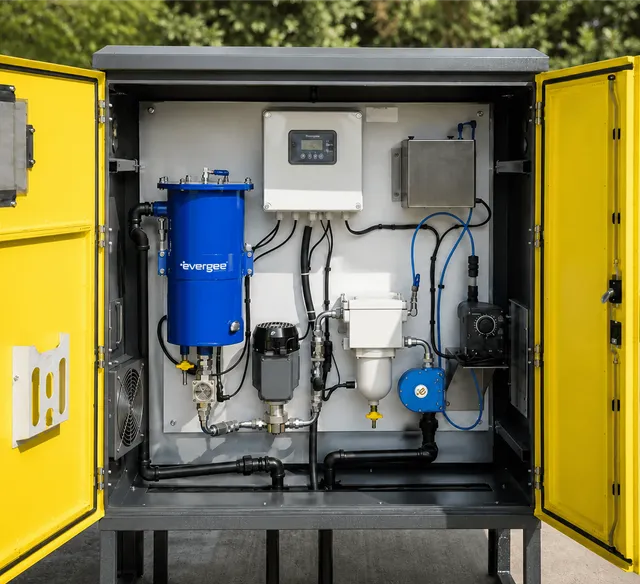
An industrial fuel polishing system is a permanently installed unit that draws diesel from a storage tank, removes water and particulates, controls microbial growth and returns the fuel to the same tank. It is also called an industrial fuel polisher or stored fuel polisher, and it works whether or not the generator is running.
That separates it from the filters already on a generator. Line filters protect equipment while fuel is moving towards the engine. They do nothing for the fuel that stays behind, and on an emergency or standby system that can be nearly all of it, for years.
| Line or engine filter | Industrial fuel polishing system | |
|---|---|---|
| Purpose | Protects equipment during fuel transfer | Keeps stored fuel within specification |
| When it works | Only while fuel is being drawn | Continuously or on a schedule |
| Water | A basic separator at most | Free and emulsified water separated and drained |
| Microbial growth | Not addressed | Controlled through biocide dosing |
| What it reports | Little or nothing | Logged readings and alarms |
Most purchase specifications lead with flow rate, and that question has its own guide: sizing a fuel polishing system. The checks below are what separate two systems with the same flow rate. If it is still unclear whether the tank needs polishing at all, start with polishing, tank cleaning or fuel replacement.
What does the filter rating actually mean?
A filter rating only means something when you know the test behind it. An absolute rating comes from a test that measures how many particles of a given size pass through the element. A nominal rating has no single agreed definition, so two elements both sold as “2 micron” can perform very differently.
Ask for the rating, whether it is absolute or nominal, and the test it was measured to, such as the ISO 16889 multi-pass test. As a reference point, a well-specified system removes solid particulates in stages to at least 2 micron absolute.
Then ask about the fuel as well as the filter. A rating describes an element. An ISO 4406 cleanliness code describes the fuel that comes out of the system, and that is the result the generator depends on. Ask what code the supplier will commit to, and where it will be measured.
Does it remove emulsified water as well as free water?
It should, and the datasheet should say so. Free water settles to the bottom of the tank and is straightforward to separate. Emulsified water is held in the fuel as fine droplets, does not settle readily and needs a coalescing stage. A system that handles only free water leaves part of the problem in circulation.
Check that claim against the fuel the site actually receives. EN 590 diesel can contain up to 7 per cent biodiesel, and biodiesel and fuel additives can make water harder to separate. Ask whether the stated performance applies to that fuel.
Ask too what happens to the water once it is out: how it is detected, where it drains and who deals with it. Where the water in a fuel tank comes from explains why the system will keep finding more.
What does it do about microbial growth?
Filtration removes microbial debris from the fuel, but it does not stop organisms growing in the water on the tank floor. A complete system adds a microbial control stage, usually controlled biocide dosing, and a way of confirming that the treatment is working.
Four questions cover most of it:
- What triggers a dose: a fixed schedule or a detected condition?
- Which product is used, and is it permitted in the country of installation? Biocides are regulated, and the rules differ between markets.
- What removes the dead biomass after treatment? It still has to be caught, so filter loading rises after a dose.
- What other chemicals are dosed, such as stabilisers, and are they compatible with the fuel specification and the engine maker’s requirements?
What microbial growth does to stored fuel covers the mechanism in more detail.
What does “automated” actually cover?
Automated fuel polishing should mean the system runs its own cycle, monitors its own condition and raises alarms with nobody in attendance. A timer on a pump does not meet that description, even if the brochure uses the word. Ask for the signal list, because it shows how much the system really knows.
A useful list includes:
- Run status and run hours
- Flow through the system
- Differential pressure across each filter stage
- Water detection
- Leak detection
- Fault and maintenance alarms
Ask whether those readings are logged, for how long, and which of them reach the site’s BMS or SCADA platform. Logged differential pressure is especially useful, because a slow rise over months is an early sign that fuel condition is changing. What BMS and SCADA integration adds goes through the signals one by one.
What happens when something goes wrong?
A polishing system is a pump connected to the site’s emergency fuel, so its own failure must never reduce the fuel available to the generator. On a leak, a blocked filter or a high water reading it should stop safely, raise an alarm and leave the generator supply untouched.
This is the question most often missing from a specification, so put it to the supplier directly:
- Is the polishing loop separate from the generator’s fuel supply?
- If a pipe breaks, can the tank siphon out through it?
- What does the system do when it loses power, and does it restart by itself?
- Can filter elements be changed without taking the tank out of service?
Ask for the answers in writing, and test them at handover.
How does it connect to the tank?
It should draw from the tank’s low point and return fuel at the far end, so that the whole tank circulates. If suction and return sit close together, the system treats a short loop of fuel and leaves the rest untouched, while every reading on the panel still looks normal.
Ask to see the tank connection drawing before placing the order. On an existing tank, ask what access is available and whether the work needs the tank to be emptied. Where a site has several tanks, ask whether one unit will serve them through a manifold, and whether the day tanks are included, because they are easy to leave out.
Is it built for the site, and can it be serviced there?
The system has to be rated for the site’s highest ambient temperature, humidity and exposure, and its filter elements and chemicals have to be obtainable locally. A unit that performs well in a temperate plant room may not suit an outdoor enclosure in the Gulf or the tropics.
Ask where replacement elements are stocked, how long they take to arrive and who attends a fault. If certificates are offered, ask which body issued them and which product they cover.
How do you prove it works at handover?
With before and after results from samples taken at the bottom of the tank and tested by an independent laboratory, plus a witnessed test of every alarm. Without that baseline, nobody can say later whether the fuel has improved or drifted. Write the procedure into the contract:
- Take bottom samples before the system first runs.
- Test water, particle count and microbial contamination independently.
- Run the agreed number of tank turnovers.
- Repeat the same tests from the same sample points.
- Trigger each alarm and confirm it reaches the BMS or SCADA.
- Record differential pressure on each stage as the baseline.
- Agree the retest interval and who owns the results.
ISO 4406 gives the particle count result and ASTM D6469 is the guide for microbial contamination. On emergency power systems, the same record supports the fuel quality testing expected under NFPA 110. How often stored diesel should be tested covers the interval.
A checklist for the specification
| What to check | A good answer | A warning sign |
|---|---|---|
| Filter rating | Absolute, with the test named | ”Nominal”, or no test given |
| Fuel result | A committed ISO 4406 code | Only an element rating |
| Water | Free and emulsified, proven on the site’s fuel | ”Water separator” with no detail |
| Microbial control | Controlled dosing of a permitted product | Filtration only |
| Automation | A written signal list, logged and sent to BMS or SCADA | A timer and a run lamp |
| Fault behaviour | Stops safely, alarms, leaves the generator supply alone | No written answer |
| Tank connection | Drawing shows low suction and a distant return | ”We will connect to what is there” |
| Handover | Independent before and after results | Supplier’s own report only |
Evergee’s FMPS is designed around these points: multi-stage filtration, free and emulsified water separation, microbiological control and controlled chemical dosing in one automated unit, with a PLC panel and BMS or SCADA integration, engineered around the site’s tanks and conditions.
Two industrial fuel polishing systems with the same flow rate can leave a tank in very different condition. Before buying, check the test behind the filter rating, the water and microbial stages, what the system does on a fault and how it connects to the tank, then write independent before and after testing into the contract.
Standards referenced: ISO 4406 for fuel cleanliness codes; ISO 16889 for multi-pass filter testing; ASTM D6469 for microbial contamination in fuels; EN 590 and ASTM D975 for diesel fuel specifications; NFPA 110 for emergency and standby power systems. Read more on Diesel Fuel Maintenance Systems and BMS, SCADA and Fuel Automation.