

How Often Should Stored Diesel Fuel Be Tested?
How often should stored diesel fuel be tested?At least once a year for emergency power systems, which is the minimum NFPA 110 sets for fuel quality testing. For data centres, hospitals and other sites where a failed start is unacceptable, quarterly sampling is the practical interval, because most diesel degradation is gradual and an annual test can miss a full cycle of it. Continuous maintenance systems shift the question from how often you test to what the test confirms.
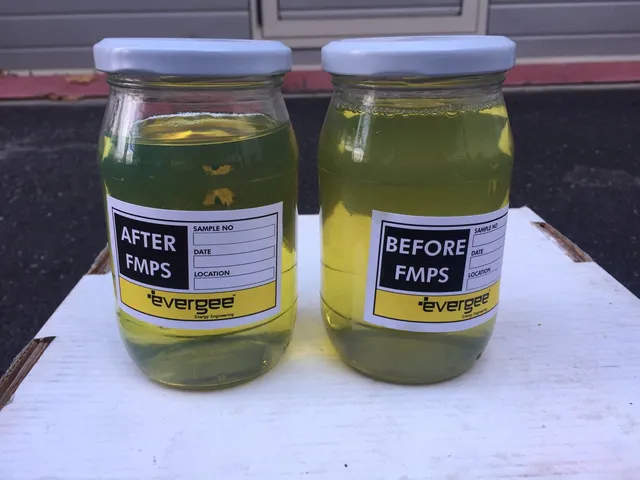
Why stored diesel needs testing at all
Diesel starts degrading from the moment it enters the tank. Three things drive it.
It is hygroscopic, so it pulls moisture out of the air in the tank headspace and holds a meaningful amount of it as emulsified water. It oxidises, which produces gums and sediment that were not in the fuel at delivery. And because it is a fossil hydrocarbon, it arrives carrying bacterial and fungal spores that colonise the fuel and water interface once there is water for them to sit in.
None of that is visible in a tank gauge. A tank can be full, correctly labelled and completely unfit to run a generator.
The reason this catches people out is that the fuel was fine when it arrived. Delivery came with a certificate, the tank was clean, and nothing since then has been done to it. Storage itself is the process that degrades the fuel, and doing nothing is what allows it to continue.
What NFPA 110 requires
NFPA 110, the standard for emergency and standby power systems, requires a fuel quality test at least annually, carried out using appropriate ASTM test methods, and requires that fuel be maintained to meet the applicable standard.
Two things about that requirement get missed.
First, it is a floor rather than a target. Annual is the minimum for compliance, and compliance is not the same as reliability. The standard sets what you must do to avoid a finding, not what you should do to be confident the generators will start.
Second, it says “using appropriate ASTM standards,” which puts the burden on you to pick the right tests. A visual inspection and a water check does not satisfy it. Neither does a supplier certificate from the last delivery, which describes the fuel as it left the depot rather than as it sits in your tank today.
What to actually test
A useful fuel panel for stored diesel covers four areas.
Water and sediment. ASTM D2709 gives water and sediment by centrifuge. This is the single most important number, because free and emulsified water enables almost every other failure mode, including microbial growth.
Particulate contamination. ASTM D6217 measures particulate by filtration. Rising particulate over successive tests tells you something in the tank is shedding, whether that is corrosion products or biological material.
Oxidation stability. ASTM D2274 for middle distillates, or D7462 where biodiesel is blended in. This is the test that predicts whether the fuel will still be usable at the next interval rather than describing where it is today. It is the one most often left off a panel, and the one that gives the most forward warning.
Microbial contamination. ASTM D6469 is the guide for microbial contamination in fuels and fuel systems, and rapid ATP-based field methods give a same-day indication. This matters because microbial growth accelerates once it starts, so a clean result last quarter is not evidence of a clean tank now.
Beyond those, the fuel should still meet its base specification. ASTM D975 defines diesel fuel oils in general use, and it is the reference the delivered product was supposed to satisfy.
What the interval should actually be
Annual testing satisfies NFPA 110. It is a poor fit for a site that cannot tolerate a failed start.
The reason is timing. Oxidation and microbial growth are slow to begin and then fast to worsen. If a tank starts going bad two months after its annual test, the next data point arrives ten months later, by which time the problem is a tank clean rather than a dose of biocide and stabiliser. The cost difference between those two outcomes is large, and it is decided entirely by when you found out.
Practical intervals by site type:
- Standard commercial standby power: annually, per the NFPA 110 minimum.
- Mission-critical facilities including data centres, hospitals, airports, telecom and financial operations: quarterly.
- Tanks with a known history of water ingress or microbial growth: monthly until two consecutive clean results, then quarterly.
- After any large delivery from a new supplier: sample on receipt, before it is mixed into the existing stock.
That last one is worth taking seriously. A delivery of poor fuel into a good tank contaminates the whole volume, and once it is mixed the only remedy is to treat everything. Testing on receipt is a small cost against that risk, and it also gives you a record if the fuel turns out to be off specification.
Sample where the problems are
Where you draw the sample changes the result more than most people expect.
Water and biological growth collect at the bottom of the tank, at the fuel and water interface. A sample drawn from the middle of the tank on a calm day can come back clean while the bottom of the same tank holds free water and an active colony. The laboratory reports exactly what you sent it, and what you sent it was the good part.
Take a bottom sample. If the tank permits it, take a bottom sample and a mid-level sample and compare them, because the difference between the two tells you how stratified the tank has become.
Three practical points on sampling:
- Sample from the same points every time. A result that moves because the sampling point moved is not a trend.
- Use clean containers and label them at the tank, not later. Mislabelled samples from a multi-tank site produce a clean bill of health for the wrong tank.
- Record the conditions: date, ambient temperature, time since the last delivery and time since the last generator run. Fuel that has just been disturbed by a transfer gives a different result from fuel that has been standing for a month.
Reading the results
A single test result tells you less than people assume. The value is in the sequence.
An absolute figure answers one question: is the fuel within specification now. That matters, and if it fails, act. But the more useful question is which direction the numbers are moving and how fast. Water content that has doubled between two quarterly tests is a finding even if both results passed, because it says water is entering the tank and the trend line reaches the limit at a date you can estimate.
Keep the results in one place, with the sampling conditions attached, and read them as a series. Four years of quarterly tests is sixteen data points, which is enough to see the seasonal pattern in water ingress at a site and to plan around it.
What to do when a test fails
Have this decided before it happens, because the pressure to defer action is real once a result arrives.
- Free water present. Drain it. Then find out how it got in, because water in a diesel tank arrives from a defect, condensation through the vent, or a failed seal, and draining the tank does not fix any of those.
- High particulate. Filter, and check whether the source is corrosion or biological. Those need different responses.
- Microbial positive. Treat with biocide and plan on filter changes afterwards, because killing a colony releases the biomass into the fuel.
- Oxidation stability failing. This is the fuel itself aging. Stabiliser treatment or turnover, depending on how far it has gone.
- Off base specification. Establish whether it was delivered that way. If it was, that is a supplier conversation with a test result behind it.
In each case, retest after treatment. Treating and assuming it worked is how a site ends up with a filter blockage during an outage six weeks later.
Testing tells you the problem exists. It does not fix it.
This is the limit of a testing programme on its own. A quarterly test with no maintenance capability behind it gives you four opportunities a year to discover the fuel has degraded, and no mechanism to do anything about it before the next test.
That is the case for continuous fuel maintenance rather than periodic intervention. A polishing and dosing system that separates water, removes particulate, neutralises biological growth and holds the chemical condition of the fuel changes what the test is for. Instead of finding out whether the fuel went bad, the test confirms the maintenance system is holding it at specification.
It also changes the economics. Periodic testing plus reactive treatment means paying for the laboratory work and then paying again, at short notice and at whatever the market rate is, whenever a result comes back bad. Continuous maintenance is a known cost that removes most of the reactive spend, and it removes the scenario where a bad result arrives during a period when the site cannot take the fuel system out of service.
That is a different question, and it is a much better one to be asking on the day the grid goes down.
Test the fuel. Then make sure something is maintaining it between tests.
Test method references are ASTM D975, D2274, D2709, D6217, D6469 and D7462, with the annual minimum from NFPA 110. Confirm the current edition of each standard for your jurisdiction before writing it into a specification.