

Diesel Bug: What Microbial Growth Does to Stored Fuel
What is the diesel bug?It is the common name for bacteria, yeasts and fungi that grow in stored diesel, living at the boundary between the fuel and any water that has collected beneath it. The organisms are already in the fuel when it arrives. What they need to multiply is water, and every storage tank eventually provides it. The result is a sludge that blocks filters, fouls injectors and corrodes the tank from the inside.
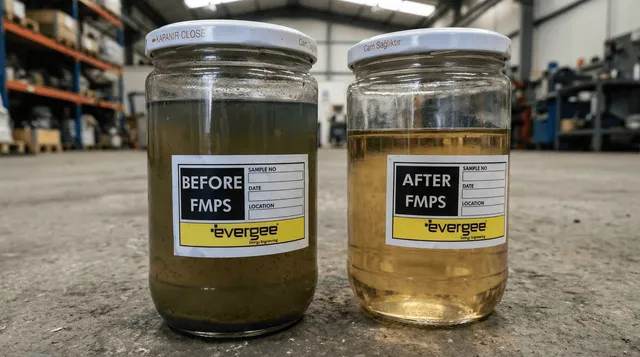
Where it grows and why
Diesel is a fossil hydrocarbon, which means it carries bacterial and fungal spores as delivered. Those spores are dormant and harmless in dry fuel.
Water changes that. Diesel is hygroscopic and continuously absorbs moisture from the air in the tank headspace, and temperature swings condense that moisture onto the tank walls, where it runs down and settles beneath the fuel. Once there is a free water layer, the interface between fuel and water becomes a habitat: water on one side, hydrocarbon food on the other, and no light or oxygen movement to disturb it.
Colonies form at that interface and along the tank walls. They metabolise the fuel, and their waste products acidify the water layer.
Biodiesel blends make it worse. The fatty acid methyl esters in FAME blends hold more water in solution than mineral diesel and are more readily digestible, so a tank running B7 or higher has a shorter window before growth becomes visible.
How fast it happens
The timeline surprises people, because it is not linear.
For months there is nothing measurable. A small population sits at the interface, limited by how much water is available and how much surface area it has to work with. Nothing on a filter, nothing in a mid-tank sample, no reason for anyone to look.
Then the population reaches a point where the biomass itself holds water and creates more interface area, and growth stops being limited by habitat. From there it doubles on a scale of days rather than months. The first visible symptom, usually a filter that blocks early, arrives when the colony is already well established.
This is the practical reason a clean annual test means very little. A tank can go from measurably clean to operationally compromised well inside a twelve-month gap, and the site finds out during a load test rather than from a laboratory report.
What it actually costs you
Four consequences, in the order they usually appear.
Filter blocking. The first symptom on almost every site is filters that need changing far more often than the schedule says. The biological matter is a soft, dark mass that plugs media quickly.
Injector fouling. Material that gets past the filters reaches the injectors, which atomise fuel evenly into the combustion chamber. Fouled injectors mean poor combustion, higher exhaust temperature and eventually mechanical damage to the engine.
Corrosion. The acids produced by microbial metabolism attack the tank floor from inside, under the water layer where no inspection reaches. Microbially influenced corrosion is a slow perforation risk, and by the time it shows externally the tank floor has been thinning for years.
Failed starts. The one that matters. A generator that will not take load during an outage, because the fuel path clogged at the flow rate a real start demands, having been fine during the light-load monthly test.
That last point is worth sitting with. A monthly no-load or light-load test run draws a fraction of the fuel that a full-load emergency start draws. A partially blocked fuel path passes the first and fails the second, which means the test regime that was supposed to give confidence is the reason the problem stayed hidden.
How to tell if you have it
Look for these together rather than in isolation:
- Filter change intervals shortening without a change in run hours.
- Dark, slimy material on the filter element rather than the fine grey deposit you would expect from particulate.
- Free water in a bottom sample, particularly if it is cloudy or has a visible layer at the interface.
- A sour or sulphurous smell from a bottom sample.
- Fuel that looks hazy rather than bright when drawn into a clear container.
To confirm it, test. ASTM D6469 is the guide for microbial contamination in fuels and fuel systems, and ATP-based field kits give a same-day indication that is good enough to trigger action. Take the sample from the tank bottom, because that is where the interface is. A mid-level sample from a contaminated tank can come back clean.
The tank design decisions that invite it
Some tanks get this problem repeatedly and others never do, and the difference is usually in how the tank was designed and installed rather than in the fuel.
Headspace and breathing. A tank that is half empty for most of the year has a large headspace, and that air is exchanged with the outside every time the temperature changes. Each exchange brings moisture in. Tanks kept closer to full breathe less and take on less water.
Vent arrangement. A vent without a desiccant or water trap is an open route for humid air. On a coastal or humid site this alone can account for most of the water in the tank.
Floor profile and the drain point. A flat-bottomed tank collects water in a thin layer across the whole floor, which is a large interface area and difficult to drain completely. A sloped floor with the water draw-off at the low point concentrates the water where it can actually be removed.
Dead legs. Any section of pipework that holds fuel and never sees flow is a reservoir the treatment never reaches. Dead legs are where a colony survives a biocide dose and re-seeds the tank afterwards.
None of these are expensive to get right at design stage. All of them are expensive to correct on an installed tank, which is why they are worth raising during fuel system engineering rather than after the first contamination event.
Why filtration alone will not fix it
This is the point most fuel maintenance programmes get wrong.
A fuel polishing system that only does physical cleaning will separate bottom water and remove solid contamination. That is necessary, and removing the habitat helps. But filtration is a mechanical process and microbial contamination is a biological one. Filters catch the biomass that has already formed. They do nothing to the organisms still in the fuel, which re-colonise as soon as water returns, and water always returns.
Worse, aggressive filtration of a heavily contaminated tank can break up an established colony and distribute it through the fuel, which turns a localised problem into a system-wide one.
Complete fuel maintenance needs three things working together:
- Water removal, including the emulsified water a simple water separator leaves behind. Emulsified water also degrades oxidation stability and raises viscosity, so this is worth doing on its own terms.
- Physical filtration to take out the solids and the biomass already present.
- Organic neutralisation, meaning controlled dosing of biocide along with the stabilisers, dispersants and detergents that keep the fuel chemically stable and unattractive as a habitat.
Take out any one of the three and the problem returns on the tank’s own schedule rather than yours.
Getting biocide dosing right
Where treatment is needed, three mistakes account for most of the failures.
Under-dosing. A partial kill leaves the resistant fraction of the population alive with less competition. Dose to the manufacturer’s shock rate for a known infestation, not to the maintenance rate.
Treating without circulating. Biocide has to reach the water layer and the tank walls, which means the tank needs to be circulated during treatment. Pouring it in the top of a static tank treats the top of a static tank.
Not planning for the filters. A successful treatment kills a large mass of organisms, and that mass then goes somewhere. Expect filter changes in the days after treatment and have elements on site before you start. Sites that skip this step get a filter blockage a week after treating, and conclude the treatment failed.
After treatment, retest. Two consecutive clean results, taken from the bottom, are what confirms it worked.
Prevention is cheaper by an order of magnitude
Treating an established infestation means shock dosing, circulating, replacing filters repeatedly, and in bad cases draining and mechanically cleaning the tank. For a large tank that is a significant outage on the fuel system, which for a critical site means running on reduced redundancy while it happens. If the site is contractually committed to a concurrently maintainable standard, that outage has to be planned, notified and worked around.
Preventing it means keeping the water out and the chemistry maintained, continuously, through a system that is already installed and already monitored. The cost difference is not close, and the difference in operational disruption is larger than the difference in cost.
Keep the water out, keep the chemistry maintained, and the diesel bug never gets a foothold.
Microbial testing reference is ASTM D6469. More on continuous fuel maintenance on the Diesel Fuel Maintenance Systems page.