

Where the Water in Your Fuel Tank Comes From, and How to Get It Out
Where does the water in a diesel storage tank come from?Mostly from the air, not from the fuel supplier. A vented tank breathes humid air in as it cools each night, and part of the moisture in that air condenses on the tank wall and runs down into the fuel. Delivery adds some, and leaking fittings add more, but condensation is the source that never stops. It is also the one that no delivery certificate can warn you about, which is why water removal has to be a function of the fuel system rather than a task someone remembers.
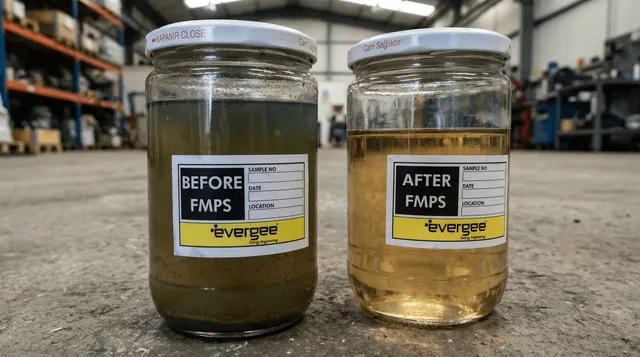
Three ways in, and only one of them is obvious
Water reaches stored diesel by three routes, and they are not equally important.
Tank breathing. This is the big one. Every vented tank exchanges air with the atmosphere as its contents expand and contract with temperature. Warm air is pushed out during the day; cooler, and usually damper, air is drawn back in at night. Some of the moisture in that incoming air condenses on the cold upper surfaces of the tank and on the fuel itself. The cycle repeats every day for the life of the tank.
Nothing about this is a fault. It is the tank working as designed. A sealed, unvented tank would deform or rupture as its contents expanded, so the vent is not optional. The consequence is that water accumulates continuously in a tank that is never opened and never refilled.
Delivery. Fuel arrives with some water in it, within whatever limit the delivery specification sets, and the road tanker or the supply line can add more. This is a real contribution but a bounded one, and it is the only route that a certificate of analysis says anything about.
Ingress. Failed gaskets on fill points and inspection hatches, corroded vent caps, damaged dip tubes and, on underground tanks, groundwater through a compromised shell. This route is intermittent and can be large. It is also the only one of the three that is genuinely a defect, so it is worth ruling out before treating an accumulation as normal.
The order matters when a tank keeps producing water after it has been drained. If the volume is steady and gradual, that is breathing. If it appears suddenly or in quantity, look for ingress before anything else.
Where the water ends up
Once inside, water separates into three forms, and they behave differently.
Free water sinks. Diesel is lighter than water, so anything that comes out of solution collects on the tank floor as a distinct layer, usually at the lowest point or under a baffle. This is the layer that shows on a water-finding paste and the one most people mean when they talk about water in a tank.
Emulsified water is held as fine droplets suspended in the fuel, kept there by agitation and by the surfactant behaviour of some additives and of FAME. It does not settle out on its own in any useful timescale. A tank can read clear on a bottom sample and still carry a significant emulsified load.
Dissolved water is held in solution, and how much the fuel can hold rises with temperature. This is the mechanism behind a nasty and common surprise: fuel that is perfectly clear at midday can drop water out of solution overnight as it cools, producing free water in a tank that nobody has opened.
That temperature dependence is the reason a warm climate is not a safe one. Warm fuel holds more dissolved water, so it carries more, and every cool period converts part of it into the free water that microbial growth needs.
What the water actually does
Water is not a contaminant that sits there inertly. It drives four separate failure mechanisms.
- Microbial growth. Bacteria, yeasts and fungi live at the boundary between the fuel and any free water beneath it. Without free water there is effectively no colony. With it, growth can be fast, and the result is the sludge and biomass that blocks filters. ASTM D6469 is the standard guide covering microbial contamination in fuels and fuel systems.
- Corrosion. Water in contact with the tank floor corrodes it, and microbial activity makes that worse by producing acidic by-products locally. The damage is at the bottom of the tank, where it is least visible and most consequential.
- Filter blocking. Free water, emulsion and microbial biomass all load filters. A generator that starts and then fails minutes later under load is often a filter problem, and a filter problem is often a water problem one step back.
- Injector and pump damage. Water is a poor lubricant and a good conductor of shock. Modern high-pressure injection equipment has tight clearances and does not tolerate it well.
None of these appear on the fuel’s delivery certificate, because none of them are properties of the fuel as it left the depot.
Finding it before it finds you
Detection is cheap, and it is the part most often skipped.
| Method | What it tells you | Where it falls short |
|---|---|---|
| Water-finding paste on a dip stick | Whether there is a free water layer, and roughly how deep | Says nothing about emulsified or dissolved water |
| Bottom sample from the tank’s low point | A real sample of the worst-case layer, suitable for laboratory work | Only as good as the sampling point and practice |
| ASTM D2709 water and sediment | A measured water and sediment figure by centrifuge | Point-in-time, and depends entirely on where the sample came from |
| Permanently installed water probe | Continuous indication, alarmed | Detects the free layer only, and needs to be in the right place |
The row that decides the value of all the others is sampling practice. ASTM D4057 covers manual sampling, and the reason it matters is blunt: a sample drawn from the middle of the tank on a tank with a water problem comes back clean, and that clean result then justifies another year of doing nothing. If you take one thing from this article, take the point that a good result from a bad sample is worse than no result at all.
Getting it out, and keeping it out
Removal splits into what handles free water and what handles everything else.
Draining the low point removes the free layer and nothing else. It is worth doing, it is cheap, and it is not a solution. It leaves the emulsified and dissolved fractions untouched, it depends on someone actually doing it on schedule, and on many tanks the true low point is not where the drain is.
Coalescing separation is the mechanism that addresses emulsion. Fine water droplets are brought together on a coalescing medium until they are heavy enough to fall out, and are then collected. This is what allows a system to remove water that will never settle on its own.
Continuous polishing is the same idea applied on a duty cycle rather than a visit. Fuel is drawn from the tank, passed through separation and filtration stages, and returned, so that the tank contents are processed repeatedly rather than treated once. The advantage is not that any single pass is better; it is that the process runs between service visits, which is when the water is accumulating.
Prevention is the other half, and it is usually cheaper than removal:
- Desiccant breathers dry the air drawn in on the breathing cycle, attacking the largest source at its entry point rather than dealing with the consequences at the tank floor.
- Fitting and hatch integrity rules out the ingress route. This is an inspection, not an investment.
- Keeping tanks full reduces the vapour space, and therefore the volume of humid air exchanged on each cycle.
- Not relying on stratification to protect the suction. Fuel drawn under load stirs the tank, and the layer that was safely at the bottom is no longer at the bottom.
What this means for a standby installation
A standby generator’s fuel sits still for months and is then asked to perform without notice. Every mechanism above runs during the sitting, and none of them announces itself.
That is the argument for handling water as a system function rather than a maintenance task. A fuel maintenance and polishing system removes free and emulsified water on a duty cycle, keeps particulate under control as the fuel oxidises, and does it without depending on anyone opening a hatch. Bringing the water alarm and the polishing duty into the BMS or SCADA platform makes the condition of the tank visible to the operations team continuously, instead of annually and in a folder.
The water in a fuel tank is not an accident and not a supplier failure. It is the predictable result of a vent, a temperature cycle and time.
Most water in stored diesel condenses out of the air the tank breathes, not out of the delivery. It arrives as free, emulsified and dissolved fractions, and only the free layer can be drained. Sample properly, dry the incoming air, and remove water continuously rather than on a visit.
Standards referenced: ASTM D6469 Standard Guide for Microbial Contamination in Fuels and Fuel Systems; ASTM D2709 for water and sediment by centrifuge; ASTM D4057 Standard Practice for Manual Sampling of Petroleum and Petroleum Products; NFPA 110 for emergency and standby power systems. Read more on Diesel Fuel Maintenance Systems.