

Day Tanks: The Part of the Fuel System That Fails Quietly
Why do day tanks cause generator failures?Because they are the smallest tank in the system and the one nobody samples. A day tank holds a short run of fuel close to the engine, refilled automatically from the bulk store. Its volume is small enough that a little water or sediment is a large proportion of the contents, its level control is a single point of failure, and returned fuel from the engine heats it in a way the bulk tank never experiences. Fuel maintenance regimes are usually written for the bulk tank and stop there.
What a day tank is for
Large fuel installations rarely feed the engine directly from the bulk store. Instead, a smaller tank sits close to the generator, holding enough fuel for a defined period of running, and is topped up automatically by a transfer pump.
There are good reasons for the arrangement. It keeps a guaranteed volume at the engine regardless of what is happening in the bulk system. It removes the need for the engine’s own lift pump to draw fuel over distance or height. It allows the bulk tank to sit where it is convenient rather than where the engine needs it. And where fire regulations limit the quantity of fuel permitted inside a building, the day tank is what keeps the installation compliant while the bulk store sits outside or underground.
NFPA 110 works in terms of the run time an installation must be able to deliver for its class, and the day tank plus the bulk store together are what provide it. The day tank is therefore a functional part of the standby provision, not an accessory.
Why the small tank carries the large risk
Four characteristics make a day tank more fragile than its size suggests.
Proportion. Two litres of water in a 20,000 litre bulk tank is a trace. The same two litres in a 500 litre day tank is a different situation entirely, and it is sitting much closer to the injection equipment.
It is the collection point. Everything the bulk tank passes on arrives here. Water carried over in the transfer, sediment disturbed by the transfer pump, biomass from a bulk tank with a growth problem: all of it ends up in the day tank, and the day tank has no downstream tank to pass it to.
Level control is a single point. A float switch, a level probe or a simple controller decides when the transfer pump runs and when it stops. That device failing in either direction produces an event: a dry day tank and a generator that will not run, or an overfill.
Heat. This one is specific to day tanks and is dealt with below.
Returned fuel is the mechanism people miss
Diesel engines circulate considerably more fuel than they burn. Fuel is delivered to the injection system, and the surplus is returned. In most installations that return goes back to the day tank.
Returned fuel is warm, because it has been through the injection system and, on many engines, past hot components. During an extended run the day tank therefore receives a continuous flow of warmed fuel into a small volume that has limited ability to shed heat.
The consequences follow directly from the physics of stored diesel. Warm fuel holds more dissolved water, so it takes up water that is then released as free water when the tank cools after the run. Warm fuel also oxidises faster, so the gum and sediment reactions run at their upper pace in exactly the tank that has the least volume to dilute the result. And a tank that spends its life cycling between warm running and ambient standing is a tank that breathes vigorously, drawing in humid air on every cool-down.
This is why a day tank can develop a water and sediment problem while the bulk tank it is fed from tests acceptably. The two tanks are not experiencing the same conditions, and testing one does not describe the other.
How they actually fail
| Failure | What happens | What it looks like |
|---|---|---|
| Level control failure, low | Transfer pump does not run; day tank empties | Generator runs for a short period, then stops, with bulk fuel still available |
| Level control failure, high | Transfer continues past the full point | Overflow to the bulk return line, to a bund, or to the floor |
| Water accumulation | Condensation and carry-over collect in a small volume | Filter blocking, rough running, injection damage |
| Microbial growth | Warm fuel plus free water at the interface | Sludge and rapid filter loading, often first seen at the engine |
| Sediment | Oxidation products plus disturbed bulk sediment | Loss of usable volume, filter loading |
| Thermal cycling | Repeated warm running and cooling | Accelerated water accumulation and oxidation |
The pattern worth noticing is that most of these present at the engine rather than at the tank. A generator that starts and then fails under load is being told something about its fuel, and the day tank is the nearest place to look.
Why it fails quietly
A bulk tank has a regime. It is dipped, it is sampled, it appears in the annual fuel quality test that NFPA 110 requires, and its condition is somebody’s responsibility.
The day tank frequently has none of that. It is small, it is usually inside a plant room, it has no obvious sampling point, and it is often not named anywhere in the maintenance schedule. Its level is monitored, because the level is what keeps the engine running, but level tells you the quantity of fuel and nothing about its condition.
So the failure is quiet in a specific sense: the instrumentation that exists is reporting normally, while the thing that will actually cause the failure is unmeasured. The tank is full. The tank is full of the wrong thing.
What to do about it
Sample it separately. The single most useful change is to stop treating the bulk tank result as describing the whole system. A day tank needs its own sample from its own low point, and it needs a sampling point that makes that practical. ASTM D4057 covers the practice; the harder part is usually that no one has provided anywhere to draw from.
Give it a drain and use it. A low-point drain on the day tank removes the free water layer that thermal cycling produces. This is cheap and it is frequently absent.
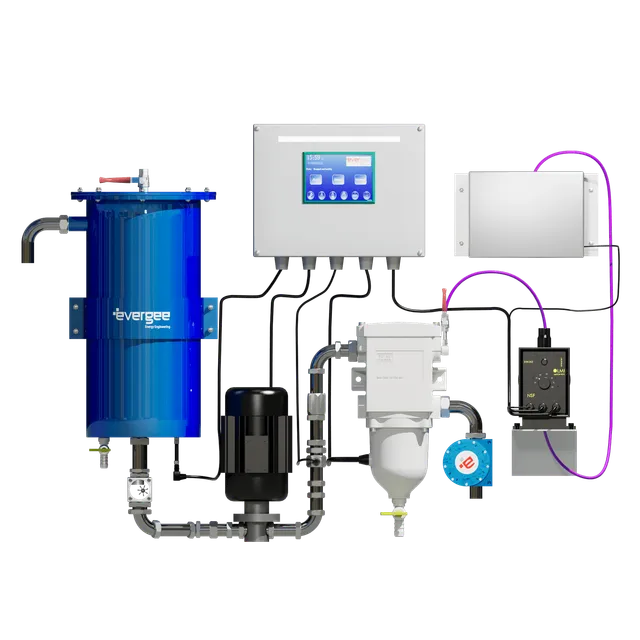
Include it in polishing. A polishing system that serves only the bulk tank leaves the tank with the worst thermal duty untreated. Extending fuel maintenance to cover the day tank, or arranging the circulation so that day tank contents are returned through the treatment path, closes the gap.
Instrument condition, not just level. A water probe and a differential pressure reading across the engine feed filter say something about the state of the fuel. Bringing those into the BMS or SCADA platform alongside the level signal is what turns the day tank from an assumption into a reading.
Check the level control deliberately. Confirming that the transfer pump starts and stops where it should is a short test, and it addresses the failure mode most likely to stop a generator outright.
Look at where the return enters. Where the engine return discharges into the day tank affects how the warm fuel mixes and where it sits. It is worth knowing, particularly on installations that run for extended periods rather than testing briefly.
The point in one line
A standby installation is usually specified around the bulk store, because that is where the volume and the cost are. The engine, however, does not draw from the bulk store. It draws from the day tank, and the day tank is the tank running warm, collecting whatever is passed to it, and appearing in nobody’s test schedule.
The day tank is small, thermally cycled by returned fuel, and fed everything the bulk tank passes on, yet it is rarely sampled. Give it its own low-point drain and sampling point, include it in the polishing circuit, and monitor fuel condition rather than only level.
Standards referenced: NFPA 110 Standard for Emergency and Standby Power Systems; ASTM D4057 Standard Practice for Manual Sampling of Petroleum and Petroleum Products; ASTM D6469 Standard Guide for Microbial Contamination in Fuels and Fuel Systems. Read more on Diesel Fuel Maintenance Systems and BMS, SCADA and Fuel Automation.