

Fully Welded Ball Valves in High-Pressure Gas and High-Temperature Lines
Where fully welded ball valves belongHigh-pressure gas transmission and distribution mains, underground district heating networks, power plant steam and hot water circuits, gas storage caverns and refinery process lines. What these have in common is not the fluid but the position: the valve is buried, encased or otherwise unreachable, and the design life expected of it is measured in decades rather than in maintenance visits. This article sets out how that requirement drives body construction, pressure class, testing and certification. It is about Böhmer valves in pipeline and high-temperature service, not about low-pressure liquid fuel distribution inside a building.
The requirement that defines the product
Start with the position rather than the valve.
A ball valve in a high-pressure gas transmission main is welded into a line that runs under a road, a field or a city street. Once the trench is backfilled, the only way to reach the valve body is to dig it up and cut it out. Nobody is going to retorque a flange on it, replace a gasket or inspect a body joint. The valve has to hold for the design life of the pipeline.
The same is true of a district heating main. It is buried, it carries hot water or steam, it cycles thermally every day of the heating season, and the network around it is under a street rather than in a plant room.
That single constraint, that the body cannot be serviced, is what separates this class of valve from everything else. It is why the body is welded through rather than bolted, why the weld is inspected by four different methods before the valve leaves the works, and why the certification the manufacturer holds matters more than the price on the line item.
Fully welded or split body
The two constructions answer two different questions, and the honest way to choose between them is to ask which problem the installation actually has.
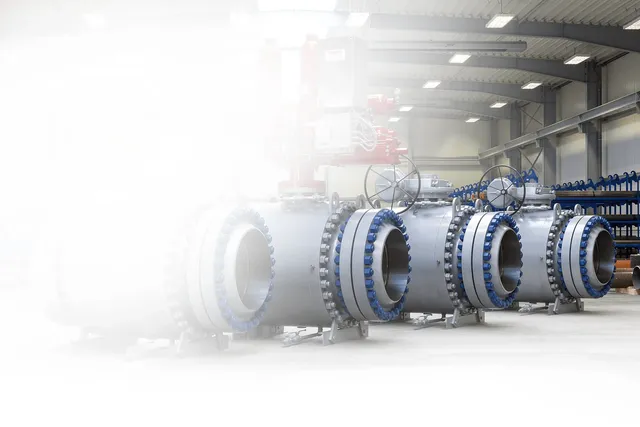
Fully welded valves have no body joint. Böhmer welds these with full penetration through the entire valve cross-section, engineered specifically to resist micro-crack corrosion and material degradation under the extreme and variable loads a pipeline valve sees. There is no bolted flange to relax over time and nothing to retorque. This is the construction for buried and encased runs, and for anything where a leak would be expensive to find and worse to reach.
Every unit is checked by visual, magnetic particle, ultrasonic and radiographic testing before it goes into service, and the process is verified by independent testing bodies. Four methods are used rather than one because they catch different defect types: surface-breaking flaws, near-surface indications, volumetric discontinuities and internal geometry each need a different technique. A valve that has passed one of them has not been proved sound.
Split-body valves trade the sealed body for serviceability. Two-piece and three-piece designs, available up to 56-inch nominal diameter, are built so that the closure assembly or internal components can be replaced without cutting the valve out of the line. That matters where the ball and seats are consumables rather than lifetime parts, which is the case in highly abrasive and corrosive media: refinery process streams, particulate-laden fluids and chemical service.
So the decision comes down to two questions. Can a technician reach this valve during a normal outage? And is the medium going to consume the internals faster than the pipeline’s design life? If the answer to the first is no, specify fully welded and treat the valve as a lifetime part. If the answer to the second is yes and the first is a clear yes, split body earns its place.
Settle this at design stage. A valve that will end up buried is a lifetime part whether or not it was specified as one.
Size and pressure class in transmission service
Böhmer’s range runs from DN 3 to DN 1400, which is 1/8 inch to 56 inch, with pressure ratings to 500 bar, Class 2500.
Transmission duty sits at the demanding end of that range and distribution sits well inside it, and the difference is worth being explicit about. A high-pressure long-distance gas transmission line runs at pressures and diameters where the valve is a major structural component of the pipeline, carrying pipeline loads as well as sealing against line pressure. A distribution main downstream of a pressure reduction station is a different specification entirely: smaller, lower class, more of them, and buried under streets where excavation is disruptive rather than merely expensive.
Two things decide the class. The first is maximum allowable operating pressure with a proper margin, not the nominal operating pressure. The second is surge. Where a valve closes quickly against flowing gas, or against a running pump on a liquid line, the transient can exceed steady-state pressure substantially, and it is a calculation rather than an allowance. Covering a surge you have not calculated by stepping up a pressure class is not a design method. It is a guess that happens to be conservative some of the time.
Temperature belongs in the same conversation. Gas storage service in particular runs to sub-zero operating temperatures with high cycle counts and variable pressure profiles, which is a material selection problem as much as a pressure one. It is why gas storage valves are specified against ISO and API requirements with low-leakage sealing systems rather than against a generic pipeline datasheet.
High-temperature service: district heating and steam
Steam and hot water valves fail in a different way from gas valves, and the design answer is different too.
The load is thermal cycling. The network heats up and cools down on a daily and seasonal rhythm, and every cycle works the seat against the ball and the body against the pipe it is welded into. Add to that the fact that the valve is underground, in soil that is wet in some seasons and frozen in others, and the material has to survive an external environment as well as an internal one.
Böhmer’s district heating and steam valves are designed for a minimum of thirty years of maintenance-free underground service, with materials selected to hold up across all climate conditions and leak-proof sealing systems. They are in use across the largest district heating projects in Europe, in everything from underground central heating networks through transmission stations to in-facility piping.
Thirty years maintenance-free is the specification to hold a supplier to, because it is the number that decides whether the network’s whole-life cost is what the design said it would be. A valve that needs attention at year twelve in a buried district heating main does not cost the price of a valve. It costs a road closure.
Power generation and gas storage
Two more positions where this class of valve is the default rather than an upgrade.
In power plant construction, whether thermal, nuclear, hydro or renewable, valves sit at the critical flow control points of processes running at high temperature and high pressure at the same time. The engineering support that comes with the valve matters here as much as the valve does, because these points are specified during construction and proved during commissioning, and a supplier who is present for both is a different proposition from one who ships a crate.
In underground gas storage, the duty is unusually punishing: very high cycle counts, pressure profiles that swing with the injection and withdrawal season, and sub-zero temperatures. A valve that would last indefinitely in steady transmission service can be worked hard in storage duty, which is why cycle life and low-leakage sealing are specified explicitly rather than inferred from a pipeline rating.
Certification: ask for the one that matches the installation
Four certification families come up repeatedly in this field, and each answers a specific question.
- API 6D is the pipeline valve specification and the baseline reference for transmission and refinery service.
- NACE material requirements apply wherever sour or corrosive conditions are credible, which in gas service means wherever H2S is present or possible.
- DNV and Lloyd’s Register approvals cover onshore and offshore oil and gas installations, where saltwater corrosion, mechanical loading and extreme climate are the design drivers.
- ISO leakage classes define what “closed” means as a number rather than as an adjective.
The instinct on a large project is to ask for all of them. That is usually the wrong instinct. A valve certified for offshore duty is not automatically the better choice for a buried inland distribution main, and paying for approvals the installation will never call on is a common way to lose budget that should have gone into cycle life or into the actuation layer.
The leakage class deserves separate attention, because it is the only one of the four that gives you something to test against later. “Tight shut-off” is not a specification. A named leakage class, verified at commissioning and recorded, is one, and it becomes the baseline every future test is measured against. Without that first number, a test in year fifteen tells you the valve leaks without telling you whether that is new.
Specialty gases and material compatibility
Oxygen, hydrogen, chlorine and other specialty industrial gases are the case where a standard valve, correctly rated for pressure and temperature, is still the wrong valve.
The constraint is material compatibility and cleanliness rather than mechanical duty. Oxygen service imposes cleanliness specifications that govern how the valve is degreased, assembled and packaged, because a contaminant that is harmless in a gas main is an ignition source in an oxygen line. Hydrogen raises permeation and embrittlement questions that are properties of the material rather than of the design. Chlorine is a corrosion problem in its own category.
These are built as a separate valve series for that reason, manufactured with particular attention to material compatibility and cleanliness specifications. If a project has one of these services in it, treat that line as its own specification exercise rather than as an annex to the main gas valve schedule.
Actuation and remote operation
Manual operation is correct where valve position only changes during planned work. Where position is part of an operating sequence, such as sectionalising a transmission line, switching between legs at a transmission station, or any position that has to change under remote command, the valve is actuated.
Hydraulic and pneumatic actuator-integrated valve systems cover automated flow control, remote operation and process optimisation. The secondary benefit is position feedback: an actuated valve can report where it is. On a buried network spread across a city, that is often the only way a control room knows the current state of the system rather than the state recorded at the last site visit.
What to settle before the line item is priced
Work through it in this order and the specification writes itself.
- Can this valve be reached after installation? If not, fully welded, and it is a lifetime part.
- Will the medium consume the internals inside the design life? If yes, and access exists, split body.
- What is the maximum allowable operating pressure, and separately, what does the surge calculation give?
- What is the temperature range, including the cold end for storage duty and the cycling profile for heating and steam?
- Which certification does this installation actually require, and which is being asked for out of habit?
- Which leakage class, and who records the commissioning figure?
- Does the valve need to move under remote command, and does the control room need to know its position?
Evergee supplies Böhmer flow control and ball valves for high-pressure gas transmission and distribution, district heating and steam, power generation, gas storage and refinery service.
Valve range, construction, testing and certification details are taken from Böhmer product documentation. See the Flow Control and Ball Valves page.