

Storing Diesel at 45°C: Fuel Degradation in Gulf Conditions
What does high ambient temperature do to stored diesel?It accelerates oxidation, which is the chemical process that turns clean fuel into gums and sediment. Reaction rates rise sharply with temperature, and the working rule of thumb is that a 10°C rise roughly doubles the rate, so an above-ground tank in a Gulf summer is running the degradation clock several times faster than the same tank in a temperate climate. Everything else in the fuel system inherits that fact.
Heat is not a stress the tank passes on to the fuel. It is the stress.
In a plant room in northern Europe, ambient temperature is a footnote in the fuel system design. In Dubai, Abu Dhabi or Doha it is the leading variable.
Diesel degrades chemically through oxidation. Dissolved oxygen reacts with unstable components in the fuel, and the products of those reactions are the gums, varnishes and insoluble sediments that block filters and foul injectors. That reaction is temperature-dependent in the ordinary way chemistry is: the hotter the fuel, the faster it proceeds.
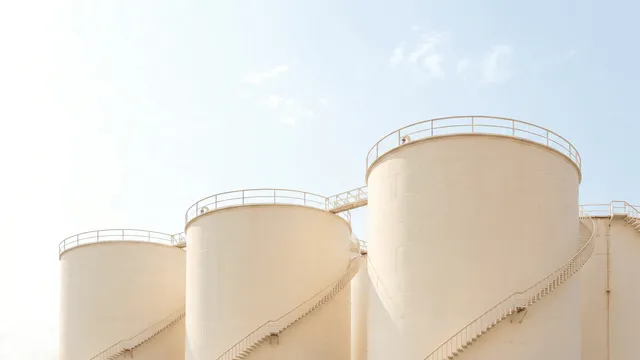
An above-ground steel tank in direct sun does not sit at ambient. It sits above it, because the shell absorbs solar radiation and passes the heat into the fuel. A tank exposed on a rooftop or a yard in the Gulf summer can hold its contents at a temperature well above the shade reading for most of the day, and it does so for months at a time.
The practical consequence is that oxidation stability, meaning how long the fuel will go before it starts forming sediment, is the property that governs storage life here, rather than water content. That is a genuine difference from a humid tropical site, where water and microbial growth lead. Both matter everywhere. Which one leads depends on the climate.
The daily thermal cycle, and what it pulls into the tank
The second thing a desert climate does is swing.
Daytime and night-time temperatures differ far more in an arid climate than in an equatorial one. That swing drives the tank’s breathing cycle hard: a large volume of air is expelled as the tank heats through the morning, and an equally large volume is drawn in as it cools overnight.
Two things come in with that air.
The first is moisture. Desert air is dry by the standards of the tropics, but it is not dry in absolute terms, and coastal Gulf sites in particular can have high humidity alongside high temperature. Water still accumulates. It accumulates more slowly than in an equatorial climate and it is more easily forgotten for exactly that reason.
The second is dust. Airborne particulate is a defining feature of the region, and an open tank vent is an entry point for it. Fine dust that reaches the fuel becomes particulate contamination that no amount of care at the delivery stage can prevent, because it did not arrive with the fuel.
Both are answered by the same component: a filtered, desiccant-type breather in place of an open vent, sized for the tank’s actual breathing volume and put on a replacement schedule. In this region the filtration function matters as much as the drying function, which is not true everywhere.
Biodiesel content and heat
Where a fuel contains a biodiesel component, heat matters more than it otherwise would.
EN 590 permits up to 7 per cent FAME in European automotive diesel. ASTM D975 permits up to 5 per cent biodiesel meeting D6751 within the diesel fuel oil grades, with B6 to B20 blends covered separately by ASTM D7467. FAME oxidises more readily than mineral diesel, so a blended fuel held at elevated temperature loses stability sooner than the same tank of straight mineral diesel would.
This is worth establishing at procurement rather than discovering at a test. Ask the supplier what the delivered fuel actually contains. Where a blend is present and the tank runs hot, oxidation stability testing moves from useful to necessary. Use ASTM D2274 for middle distillate oxidation stability, and ASTM D7462 where a biodiesel blend is involved.
What a hot-climate fuel system does differently
Six choices separate a fuel system designed for these conditions from one specified against a temperate-climate template.
- Get the tank out of the sun. Underground or vault installation, shading, or a light-coloured reflective coating on an above-ground shell. This is the single most effective change available and it is a siting decision, so it has to be made early.
- Insulate where the tank cannot be moved. Insulation on an above-ground tank cuts both the peak temperature and the size of the daily swing, which means it works on oxidation and on breathing at the same time.
- Fit a filtered desiccant breather. For dust as much as for moisture, as above.
- Specify oxidation stability as a test, not an assumption. In this climate it is the property most likely to fail first, and it is the one least likely to be visible in a look at a sample jar.
- Keep the fuel moving. Static fuel at elevated temperature is the worst case. A fuel maintenance and polishing circuit that circulates the tank contents on a schedule breaks up the thermal stratification, keeps water and particulate moving toward the point where they can be removed, and gives the system something to report.
- Watch the day tank, not only the bulk tank. A day tank in a hot generator room is often the hottest fuel on the site and it is frequently ignored, because attention goes to the large tank outside. Fuel that has been recirculated back from a running engine is hotter still.
Testing interval when heat is the driver
NFPA 110 sets an annual fuel quality test as the minimum for emergency and standby power systems.
Where fuel is stored at consistently elevated temperature, quarterly is the interval that makes sense, and the reasoning is the same as it is in a tropical climate even though the mechanism differs. If degradation is running several times faster than the rate the annual figure was framed around, an annual test is sampling too coarsely to catch a problem before it becomes an event.
What to test, in rough order of relevance here:
- Oxidation stability. The property heat attacks directly.
- Particulate contamination (ASTM D6217). Because of dust ingress as well as fuel-borne sediment.
- Water and sediment (ASTM D2709). Lower priority than in the tropics, never zero.
- A microbial check (ASTM D6469 as the guide). Heat does not remove the risk, and coastal sites in particular still see it.
The sampling arrangement should allow a bottom sample. Whatever is wrong in a tank shows up at the bottom of it first.
Where this shows up in the region’s project pipeline
The facilities being built across the UAE and Qatar right now concentrate exactly the conditions described above: large fuel stores, long standby intervals, and an environment that works on the fuel every day.
Hyperscale and colocation data centres hold enough fuel for extended autonomy, which means large volumes turning over slowly. Airports run standby plant for systems that cannot be allowed to fail. Hospitals are required to start on demand. Large mixed-use and industrial developments carry generator plant sized for life-safety systems and often for far more.
In every case the generators, switchgear and controls are maintained on a schedule and the fuel is assumed to be fine because it was on specification when it arrived. In a climate that degrades it several times faster than the one the assumption came from, that is the weakest link in an otherwise well-maintained chain.
In Gulf conditions, oxidation is the mechanism that leads and heat is what drives it. Get the tank out of the sun, insulate what cannot be moved, filter and dry the air coming in, keep the fuel circulating, and test oxidation stability quarterly rather than annually.
Standards referenced: EN 590 and ASTM D975 for diesel requirements, ASTM D7467 for B6–B20 blends, ASTM D2274 and D7462 for oxidation stability, ASTM D6217 for particulate, ASTM D2709 for water and sediment, ASTM D6469 for microbial contamination, and NFPA 110 for emergency and standby power systems. Read more on Diesel Fuel Maintenance Systems.