

Fuel Cleanliness and ISO 4406: Keeping Dust Out of Generator Diesel
What is an ISO 4406 fuel cleanliness code?It is a three-number code that says how many solid particles a fuel sample contains at three sizes: 4, 6 and 14 micrometres and larger, counted per millilitre. Each number is a step on a scale where every step up roughly doubles the particle count. A lower code means cleaner fuel. For modern common-rail generator engines, it is the measure that matters, because the particles that damage them are too small to see.
Why cleanliness became a specification
Older diesel engines tolerated a fair amount of dirt. A worn injector ran badly, but it ran.
Modern engines are different. Their common-rail injection systems work at tolerances of 2 to 4 micrometres and at pressures up to 30,000 PSI. At those clearances, particles that an older engine would have passed through now cut and wear the injector, and an injector that has been worn this way does not deliver fuel properly under load.
The emissions rules are the reason the injection systems changed. Engines built to the later emission stages, such as US EPA Tier 4, depend on very precise injection, so the fuel reaching them has to be cleaner than it ever had to be before. “Clean fuel” stopped being a description and became a number.
That number is usually an ISO 4406 code.
How to read an ISO 4406 code
An ISO 4406 result looks like three numbers separated by slashes, for example 18/16/13.
- The first number covers particles of 4 micrometres and larger.
- The second covers particles of 6 micrometres and larger.
- The third covers particles of 14 micrometres and larger.
Each number is not a count. It is a scale step that stands for a range of counts per millilitre, and each step up roughly doubles the count. So a fuel at 19 on the first number has around twice as many fine particles as a fuel at 18, and a fuel three steps higher has around eight times as many.
That doubling is the thing to keep in mind when reading a report. A result that “only” moved up two steps since the last test has roughly four times the particles it had before.
The count is made by an automatic particle counter. ASTM D7619 covers that measurement in light and middle distillate fuels.
A clear sample can still fail
The human eye stops resolving particles at around 40 micrometres. The particles that matter to a common-rail injector are a tenth of that size.
So a sample that looks bright and clear in a jar tells you only that there is nothing large in it. It says nothing about the fine particles that do the damage. Evergee’s video on contamination at 40 μm against 2 μm shows the difference. This is why a particle count belongs in the test schedule even on a tank whose fuel looks perfect.
Where the particles in a desert-site tank come from
Some particulate arrives with the fuel, picked up during transport and transfer. Some forms inside the tank as fuel ages and oxidises. At inland sites across Saudi Arabia, the UAE and Qatar, a third source is often the largest: airborne dust.
It gets in through several routes:
- The tank vent. Every daily heating and cooling cycle pushes air out and draws air back in, and in a desert climate that cycle is large. Each breath brings in whatever is in the air. The article on storing diesel at 45°C covers the breathing cycle in more detail.
- The fill point. Delivery hoses, couplings and caps sit in a dusty yard. Whatever is on them at connection goes into the tank with the fuel.
- Opened hatches. Every manual dip, inspection or sample taken through an open hatch is a few minutes with the tank open to the air.
- Filter changes. A filter housing opened on a windy day can let dust past the very element that is supposed to stop it.
- Construction nearby. Many generator plants in the region are commissioned beside sites that are still being built, and the air around them carries far more dust than it will once the site is finished.
Desert dust is mineral. It is hard and abrasive, which makes it more damaging per particle to an injector than the softer sediment that forms from fuel ageing.
Hard particles and soft particles need different tests
A particle count says how many particles there are. It does not say what they are.
That is why two tests are worth running together. The ISO 4406 count shows the fine particles that threaten the injectors. A gravimetric test, ASTM D6217, filters a measured volume of fuel and weighs what is left, which shows the total mass of contamination.
Read together, they help locate the source. Many fine particles and little mass points to fine dust. A high mass with a moderate count points to heavier sediment and the products of fuel ageing, which is a question about oxidation and points back to the tank, as covered in polishing, tank cleaning or replacement.
Setting the target
The cleanliness target should come from the engine manufacturer. Ask for it in writing, as an ISO 4406 code, for the fuel at the engine inlet.
Two practical points follow from that.
The engine’s own filters are the last line of defence, not the cleaning stage. If the fuel reaching them is far dirtier than the target, they block early, and a blocked filter during an extended run is a failure in its own right. The fuel in the tank should already be close to the target.
The target applies to the day tank as well as the bulk tank. The day tank is the fuel the engine actually draws, and it is often the one nobody tests. See day tanks: the part of the fuel system that fails quietly.
What keeps a tank at its target
- Filter the air going in. A filtered desiccant breather on the vent, sized for the tank’s breathing volume and on a replacement schedule. At a desert site the particulate filtering matters as much as the drying.
- Filter the fuel going in. A filter on the fill line catches what the delivery brings, including what was on the hose.
- Keep the tank closed. Level gauges and sampling points that work without opening a hatch remove a route most sites do not think about.
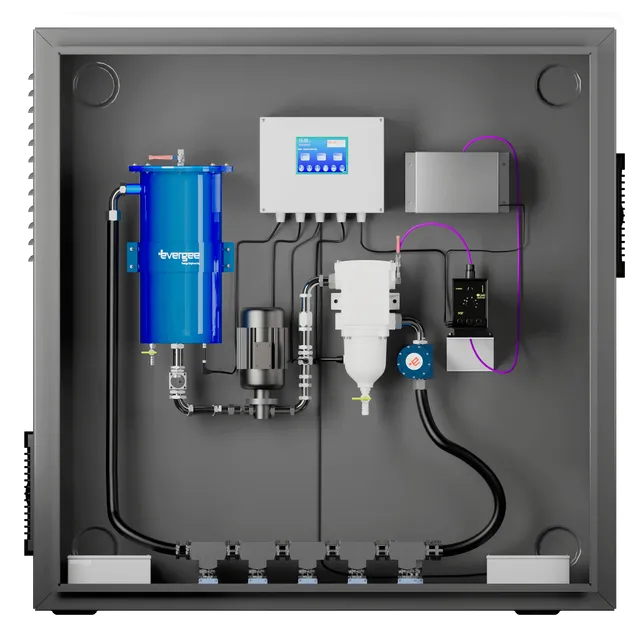
- Polish to a stated rating. A fuel maintenance system with staged filtration removes what gets in anyway. Evergee’s systems filter to 2 micron absolute and report results against ISO 4406.
- Trend the filter differential pressure. A rising trend is the earliest sign that more dirt is reaching the tank than before, and it shows up between tests.
- Test on a schedule. A particle count and a gravimetric result, taken from the bottom of the tank, at the interval set out in how often stored diesel should be tested.
An ISO 4406 code is a count of particles too small to see, on a scale where every step doubles. Common-rail engines need fuel that meets a code, and at desert sites in Saudi Arabia and across the Gulf, airborne dust is often the main thing working against it. Filter the air and the fuel going in, polish to a stated rating, and test for both count and mass.
Standards referenced: ISO 4406 for solid particle contamination codes; ASTM D7619 for automatic particle counting in distillate fuels; ASTM D6217 for particulate contamination by filtration. Read more on Diesel Fuel Maintenance Systems.