

ASTM D975 and EN 590: What a Fuel Specification Does Not Cover
What do ASTM D975 and EN 590 actually guarantee?That the fuel met a defined set of properties when it was supplied. ASTM D975 is the American specification for diesel fuel oils; EN 590 is the European specification for automotive diesel. Both are delivery specifications. Neither makes any statement about the condition of that fuel after it has sat in a storage tank for a year, which is the condition a standby generator actually runs on.
Two specifications, one purpose
ASTM D975, Standard Specification for Diesel Fuel, and EN 590, Automotive fuels. Diesel. Requirements and test methods, do the same job for different markets. Each defines the properties a diesel fuel must have to be sold as diesel, and each names the test method by which every property is measured.
They are the reference point for a fuel purchase almost everywhere. A project in Singapore, Kuala Lumpur, Dubai, Doha or Lagos will find fuel offered against one or the other, sometimes against a national standard derived from one of them.
Both are written from the perspective of the engine. The question they answer is: will this fuel burn correctly and cleanly in a compression-ignition engine when it is supplied to that engine? The properties they control follow from that question: cetane, density, viscosity, sulphur, cold flow behaviour, water and sediment, and so on.
That framing is exactly right for road transport, where fuel goes from a refinery through a distribution chain and into a vehicle tank that empties within days. It is only partly right for standby power, where the fuel sits.
Where the two differ, in the ways that matter for storage
The full comparison runs to dozens of properties. Three differences are the ones that change a storage decision.
Biodiesel content. EN 590 permits up to 7 per cent FAME in the fuel. ASTM D975 permits up to 5 per cent biodiesel meeting ASTM D6751 within the diesel fuel oil grades, and blends from B6 to B20 are covered by a separate specification, ASTM D7467. This matters because FAME behaves differently in storage from mineral diesel: it holds more water, it oxidises more readily, and it supports microbial growth better. A fuel that is compliant on the day it is delivered can be the harder fuel to store.
Cold flow. EN 590 handles cold weather through national annexes that set seasonal and climate-dependent grades, so the same standard produces different fuels in different countries and seasons. ASTM D975 addresses it through grade selection and a cloud point that is reported rather than fixed to a single limit. For most of the markets under discussion here, equatorial and Gulf, cold flow is not the binding constraint. It becomes one for projects in Central and Eastern Europe.
Water content. Both specifications limit water, and the way they express the limit differs: EN 590 states a water content in mg/kg, while D975 works through a combined water and sediment limit measured by centrifuge (ASTM D2709). The practical point for a specifier is that the limit is on the fuel as delivered, not on the fuel in the tank, and the two are different numbers within weeks.
Where a project sits in a market that uses a national standard, it is worth establishing which of the two it derives from and what has been changed. That is a supplier question with a short answer, and it is more useful than the assumption that all diesel is the same diesel.
The properties that decide whether stored fuel still works
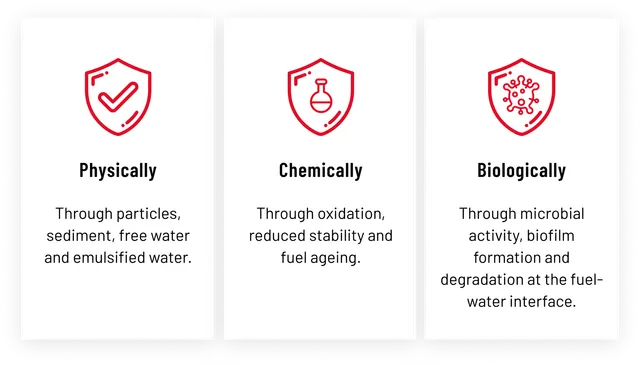
Here is the gap, stated plainly. A delivery specification controls the properties that matter at the point of sale. A stored fuel fails on a different set of properties, and most of them are not on either certificate.
- Oxidation stability. How long the fuel will resist forming gums and sediment. This is the property that determines storage life, and it is the one that degrades from the day of delivery onward.
- Accumulated water. Not the water that came with the fuel, but the water that condenses out of tank breathing over months and years. There is no delivery test that predicts it, because it is a function of the tank and the climate rather than of the fuel.
- Microbial population. Bacteria, yeasts and fungi that arrive dormant in the fuel and multiply once free water is present. ASTM D6469 is the guide covering microbial contamination in fuels and fuel systems, and it exists precisely because this is a storage-phase problem rather than a specification problem.
- Particulate load. Sediment that forms in the tank as the fuel oxidises, plus anything that entered through the vent. ASTM D6217 covers particulate contamination measured by laboratory filtration.
- Filter blocking tendency. How readily the fuel will block a filter element, which is a more direct predictor of a failed start than any single chemical property.
A certificate of analysis from the supplier covers none of these as they stand today. It is a record of the past.
Which tests answer which question
For a facility that has to prove its standby fuel is usable, the useful move is to separate the two sets of tests explicitly.
| Question | What to ask for |
|---|---|
| Was the fuel compliant when delivered? | The supplier’s certificate against ASTM D975 or EN 590, and the actual biodiesel content |
| Is there free water in the tank? | A bottom sample, plus ASTM D2709 water and sediment |
| Is the fuel oxidising? | ASTM D2274 oxidation stability, or ASTM D7462 where a biodiesel blend is present |
| Is there a microbial problem? | Sampling and testing framed by ASTM D6469 |
| How dirty is the fuel? | ASTM D6217 particulate contamination |
| Was the sample taken properly? | ASTM D4057 manual sampling practice |
The last row is not filler. A sample drawn from the wrong point in a tank produces a clean result on a dirty tank, and that result then justifies doing nothing for another year. Sampling practice is the part of this that is most often got wrong and least often questioned.
What the compliance standards ask for on top
NFPA 110, the standard for emergency and standby power systems, sets an annual fuel quality test as a minimum. That requirement exists because the delivery specification does not cover the storage phase, and somebody has to.
An annual test is a floor rather than a target. Where the storage environment is aggressive, either humid or hot, quarterly sampling is the interval that catches degradation while it can still be corrected rather than after it has produced sediment. That is a judgement about rate, not about caution: if the mechanisms run several times faster in one climate than another, the sampling interval should follow.
The design implication
If a delivery specification cannot describe the fuel a generator will actually be given, then the fuel system has to.
That is the whole argument for treating fuel as a maintained component rather than as a consumable purchase. A fuel maintenance and polishing system manages the properties the specification does not reach: it removes water and particulate continuously rather than at a service visit, it keeps the tank contents moving so that nothing stratifies, and it supports treatment when a microbial test comes back positive. Connecting it to the BMS or SCADA platform turns the result into something the operations team can see rather than something that lives in a folder.
The purchase specification tells you what you bought. Only the fuel system tells you what you have.
ASTM D975 and EN 590 describe fuel at the moment of delivery. Storage life is governed by oxidation stability, accumulated water, microbial growth and particulate load. None of those appear on a delivery certificate. Test for those separately, and design the fuel system to manage them.
Standards referenced: ASTM D975 Standard Specification for Diesel Fuel; EN 590 Automotive fuels. Diesel; ASTM D6751 and D7467 for biodiesel and blends; ASTM D2274 and D7462 for oxidation stability; ASTM D2709 for water and sediment; ASTM D6217 for particulate; ASTM D4057 for manual sampling; ASTM D6469 for microbial contamination; NFPA 110 for emergency and standby power systems. Read more on Diesel Fuel Maintenance Systems.