

Why Diesel Quality Is Critical for Emergency Power
In mission-critical data center environments, emergency power systems are typically assessed through generator capacity, UPS autonomy, switchgear reliability, controls and redundancy architecture. However, one essential element is often underestimated: the condition of the diesel fuel stored on site.
A generator can only perform as reliably as the fuel delivered to its engine.

Why is fuel quality critical to emergency power availability?
Diesel is not a static asset. In long-term storage it deteriorates through water accumulation, particulate contamination, sediment, oxidation, fuel ageing and microbial activity. For a critical facility, fuel availability is not only a question of how much is in the tank, but of whether that fuel still meets the engine’s requirements when utility power is lost.
How stored diesel degrades
| Type | What happens | What it leads to |
|---|---|---|
| Physical | Particles, sediment, free water and emulsified water accumulate | Filter blockage, injector problems |
| Chemical | Oxidation, reduced stability, fuel ageing | Fuel that no longer meets specification |
| Biological | Microbial activity and biofilm at the fuel-water interface | Sludge, corrosion, unreliable operation under load |
STORED DIESEL FUEL QUALITY: A CRITICAL FACTOR IN EMERGENCY POWER AVAILABILITY
Diesel fuel is not a static asset. During long-term storage, its condition can deteriorate due to water accumulation, particulate contamination, sediment formation, oxidation, fuel ageing and microbial activity. Water at the bottom of a storage tank can create a favorable environment for bacteria and fungi, leading to biofilm formation, sludge, filter blockage, corrosion, injector issues and unreliable generator operation under load.
For critical facilities, fuel availability is therefore not only a matter of volume. It is a matter of quality, stability and readiness.
The key question is not simply whether there is enough diesel in the tank. The real question is whether the fuel will still meet the operational requirements of the engine when utility power is lost and the emergency power system is called to perform.
FUEL MAINTENANCE IS A RELIABILITY DISCIPLINE, NOT JUST FILTRATION
Traditional fuel polishing practices are commonly associated with the removal of water and particulate contamination. This is an important part of stored fuel management, but it should not be considered a complete reliability strategy.
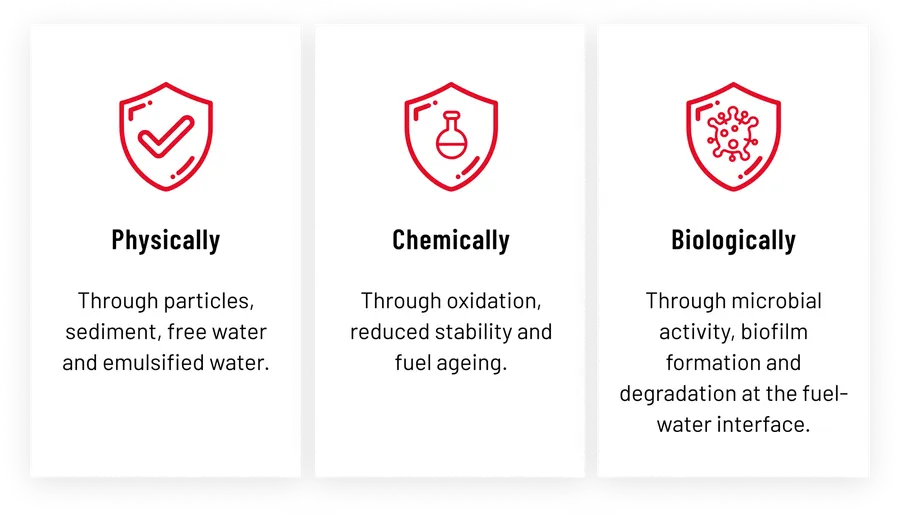
Stored diesel fuel can degrade in three different ways:
- Physical Degradation: Particles, sediment, free water and emulsified water accumulation.
- Chemical Degradation: Oxidation, reduced stability and fuel ageing.
- Biological Degradation: Microbial activity, biofilm formation and degradation at the fuel-water interface.
For data centers, hospitals, financial institutions, telecom facilities and other critical infrastructure, fuel maintenance must therefore be managed as a continuous reliability discipline rather than a periodic cleaning activity.
This is the basis of EVERGEE’s 360° fuel maintenance approach. It combines physical fuel cleaning and controlled chemical protection within a single integrated system architecture, supporting long-term fuel stability and emergency power readiness.
WHY DELIVERY COMPLIANCE ALONE IS NOT ENOUGH
International fuel standards provide important reference points. ASTM D975 defines widely recognized specifications for diesel fuel oils, while EN 590 sets out key requirements for automotive diesel fuel in Europe.
However, compliance at the point of delivery does not guarantee compliance after prolonged storage.
A fuel sample may meet ASTM D975 or EN 590 requirements when delivered, yet still deteriorate over time due to tank conditions, humidity, temperature variation, condensation, water contamination and microbial growth. In a data center environment, this creates a direct operational risk: fuel that was acceptable at delivery may no longer be suitable when the generator is required to operate under emergency conditions.
This is why leading critical infrastructure practices emphasize regular inspection, testing and management of stored diesel fuel. Uptime Institute guidance highlights the importance of controlling water, sediment and microbial growth in stored fuel systems, while permanent fuel maintenance systems can support long-term availability. NFPA 110 also treats fuel quality testing and monitoring as an important maintenance requirement for emergency and standby power systems.
For executive decision-makers, the issue is clear: stored fuel must be treated as part of the availability strategy, not merely as a consumable.
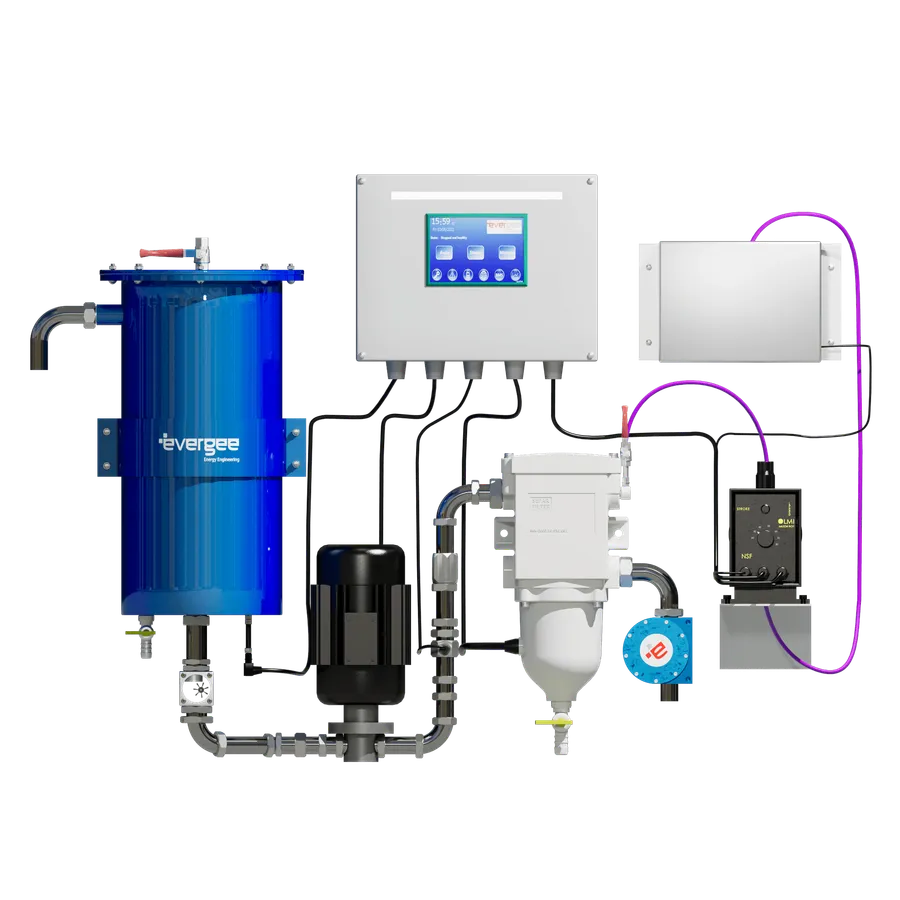
EVERGEE 360° FUEL MAINTENANCE
EVERGEE approaches diesel fuel in critical facilities as a strategic reliability asset. The objective is not only to clean fuel after contamination occurs, but to maintain fuel condition continuously and reduce the risk of degradation before it becomes a generator availability issue.
EVERGEE 360° fuel maintenance systems integrate:
- Particulate filtration,
- Free water and emulsified water separation,
- Fuel stability management,
- Controlled chemical conditioning,
- Microbial risk reduction,
- Continuous protection of the tank and generator fuel circuit.
This integrated approach helps ensure that stored diesel fuel remains cleaner, more stable and more reliable throughout its storage life.
In other words, the fuel is not simply polished. It is protected, conditioned and maintained in a state of operational readiness.
CONCLUSION
Emergency power availability in data centers depends on more than generator design, system redundancy and fuel quantity. It also depends on the quality and stability of the fuel that reaches the engine at the critical moment.
Effective fuel maintenance must address physical contamination, water management, chemical degradation and biological risk together. EVERGEE’s 360° fuel maintenance approach provides an integrated framework for managing stored diesel fuel as a critical component of operational continuity in data centers and other mission-critical facilities.
Because in a critical facility, stored fuel is not just fuel. It is part of the availability chain.